Design Psychology · August 3, 2026
The Cosiest Room on Earth Is at the Bottom of the World
Wind at 160 km/h, no sunrise for 105 days, and a research station that hired a colour psychologist anyway. What Halley VI's red social module teaches every room that has nowhere else for you to go.
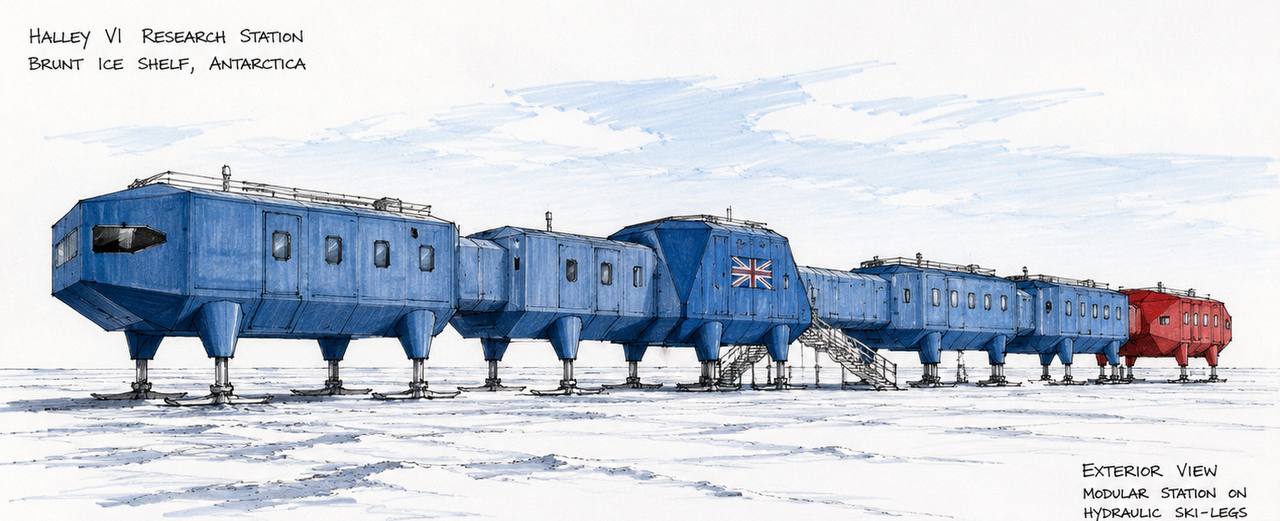
Wind hits 160 km/h. The sun doesn't rise for 105 days a year. The ground underneath is a slab of floating ice sliding toward the ocean at roughly 400 metres a year, and the building sitting on it is designed to detach its own legs and ski itself somewhere safer if that ice ever threatens to break away as an iceberg. Somewhere inside all of that, the interior brief for one room said it "should feel uplifting."
That building is Halley VI, the UK's most southerly research station, run by the British Antarctic Survey on the Brunt Ice Shelf. I run YaDesign Inc., a studio working out of Toronto and Los Angeles, and most of what crosses my desk is nowhere near this extreme. But the question Halley VI answers is one I ask on every project, just at a much gentler scale: what does this room do to the person inside it, hour after hour, when there's nowhere else for them to go?
A design brief written for people, not just survival
Halley VI sits on a slab of floating ice 150 metres thick. Temperatures drop to -56°C. The station replaced an earlier version, Halley V, after the ice shelf underneath it started cracking in ways nobody could safely ignore. So the new station was built as a line of blue modules on hydraulic ski-legs, engineered by Hugh Broughton Architects and AECOM to be towed inland whenever the ice underneath gets unstable. Structurally, it's one of the most hostile-environment buildings on the planet.
Engineering the shell was only half the brief. The other half was psychological: how do you keep sixteen people functioning through nine months of physical isolation and 105 sunless days, packed into a run of steel modules on skis? The answer the design team landed on wasn't more insulation. It was colour.
The room that fights back against the dark
The station's social hub is a single module everyone just calls the red module, and it's deliberately, almost aggressively warm-toned. Not a safe neutral. A saturated, cheerful red, chosen to push back against the sensory flatness of an all-white, all-dark landscape outside the window.
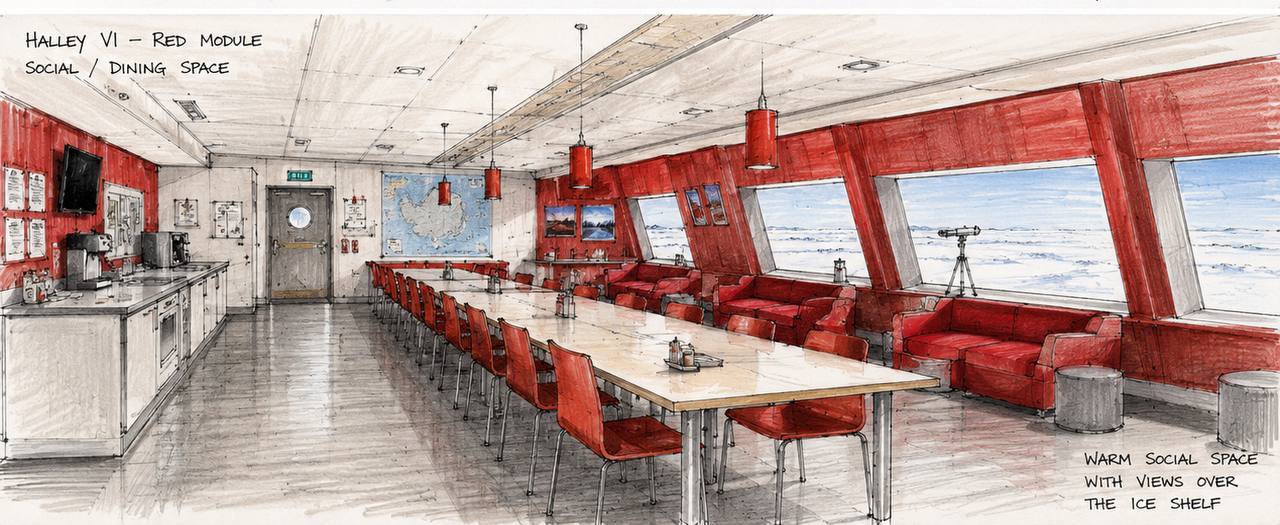
This wasn't a mood-board decision. The colour scheme came out of consultation with a colour psychologist brought in to work against the flattening effect of months of seeing nothing but white snow and black polar night. It's a specific, documented use of colour as a counter-measure, not decoration for its own sake.
The lamp doing more work than the paint
Bedrooms go further. They're fitted with lighting that simulates the change in daylight and runs on an alarm cycle, gradually brightening each room every morning rather than switching on at full strength. It's the same principle behind the dawn-simulator lamps some people already use at home through a dark winter, built directly into the fixture instead of sold as an add-on. Where the room colour is a supporting layer, this lighting is the piece with the stronger evidence behind it, aimed at nudging the body's internal clock awake on a schedule that months of polar night would otherwise erase.
The paint colour is a supporting layer. The lamp is closer to a clinical tool. Neither one is decoration.
Why this is bigger than one weird building
Antarctic stations, submarines, and underground bunkers all sit in a category researchers call ICE environments: isolated, confined, extreme. That research line traces back to NASA's earliest crewed space program in the 1960s, when scientists first studied how astronauts held up psychologically inside tiny, sealed cabins with no view and no way out.
That early work became the foundation for a field that keeps growing: designing interiors specifically to protect the mental state of people who genuinely can't leave. Antarctic stations are now treated as real-world stand-ins for future Mars habitats, precisely because the underlying problem is identical — a small group of people, sealed into a small space, for a long time, with no exit.
Which means Halley VI's red module and its daylight-simulating lamps aren't polar trivia. They're the same logic sitting underneath every conversation about biophilic design, circadian lighting, and "wellness" interiors that gets thrown around in real estate listings today. The difference is margin. At Halley VI there's no room for any of it to be decorative. If the colour scheme fails, the crew's day-to-day mood measurably suffers, in a place with no corner café to escape to and no quick fix if it goes wrong.
The takeaway for rooms that aren't in Antarctica
Almost nobody I work with is designing for -56°C and total isolation. But the question Halley VI answers so cleanly is one every interior designer quietly wrestles with anyway: what does this room do to the person inside it, hour after hour, when there's nowhere else for them to go?
A home office with one small window. A windowless basement rec room. A north-facing apartment that barely sees sun from November to February. These are ICE environments too, just far milder ones. Halley VI is simply the version where the stakes were high enough that nobody could afford to treat colour and light as an afterthought. Most homes get to treat it as optional. That doesn't mean it's not worth doing.
How to borrow the idea without the -56°C
You don't need a colour psychologist on retainer to use this. Here's the order I'd actually work through, on a basement, a home office, or any room that gets cut off from real daylight for months at a time.
- Fix the light first. Layer real, warm lighting (ambient, task, and accent, ideally around 2700–3000K) before you touch paint. It's the harder-evidenced piece of Halley VI's approach and it does more of the work.
- Pick one saturated colour, not a safe beige. If a room reads flat and grey most of the year, a warm, deliberately chosen colour on one wall or in upholstery counters that better than another coat of neutral.
- Give the room one job. Halley VI's red module isn't trying to be a gym, an office, and a lounge at once. A room that's clearly for one thing — eating, working, unwinding — is easier to design well and easier to actually enjoy.
- Treat the fix as ongoing, not a one-time purchase. A dawn-simulator lamp or a bolder colour won't rescue a room you never use. Pair the change with an actual routine — eating at the table, working at the desk with the light on — the way the station's schedule builds the lighting cycle into the day.
If you're staring at a basement or office that's been quietly making your winter worse and want a second opinion, a virtual design consultation is the low-commitment way to start; for a full room, that's residential interior design. Either way, book a consultation and bring the room's real light situation, not just a colour you like.
Sources
- British Antarctic Survey — Halley VI Research Station. bas.ac.uk
- Hugh Broughton Architects — Halley VI project. hbarchitects.co.uk
- AECOM — Halley VI engineering. aecom.com
- Research on Antarctic and polar station design as an analogue for space-habitat psychology, building on NASA's early crewed-spaceflight studies of isolated, confined, extreme (ICE) environments.
People also ask
- Why is Halley VI's social module painted red?
- The station's design team brought in a colour psychologist specifically to counter the effect of months of white snow and black polar night. Red was chosen as a deliberate, saturated contrast to that landscape, applied to the one room built for the whole crew to eat and socialise in. It's a design decision made for a psychological reason, not a stylistic one.
- What is Halley VI?
- Halley VI is the UK's most southerly Antarctic research station, run by the British Antarctic Survey on the Brunt Ice Shelf. It's built as a line of blue modules on hydraulic ski-legs, with one red social module at the end, and the whole thing can be towed inland if the ice shelf it sits on threatens to crack off. Architects Hugh Broughton Architects and AECOM designed it, replacing an older station that got stuck on unstable ice.
- Can a paint colour actually help with seasonal low mood?
- Treat colour as one supporting factor, not a fix on its own. Research on light and mood is much stronger than research on wall colour specifically, and daylight-simulating lighting is the better-evidenced piece of what Halley VI does. Where colour genuinely helps is in making a windowless or low-light room feel less flat day to day. For anyone dealing with diagnosed seasonal affective disorder, a clinician is the right first call, not a paint chip.
- What are ICE environments?
- ICE stands for isolated, confined, and extreme — the term researchers use for Antarctic stations, submarines, and long-duration space habitats. The category matters because the psychological problem is the same in all of them: a small group of people sealed into a small space for a long stretch, with no way to just leave. Antarctic stations are now studied partly as a stand-in for future Mars habitats for exactly that reason.
- How does Halley VI's daylight-simulating lighting work?
- Bedrooms are fitted with lighting that mimics the change in daylight and runs on an alarm cycle, gradually brightening each morning instead of switching on at full intensity. The idea, similar to the dawn-simulator lamps some people use for winter mornings at home, is to nudge the body's internal clock awake on a schedule that months of polar night would otherwise erase.
- What's a home equivalent of an ICE environment?
- Any room where you spend hours with no real view and nowhere else to go: a windowless basement rec room, a home office with one small window, a north-facing apartment that barely sees sun from November to February. The stakes are lower than Antarctica, but the design question is identical — what is this room doing to the person stuck in it, day after day?
- How do I apply this to a room in my own house?
- Start with light, not paint. Add the strongest, warmest lighting layer you can to whatever daylight the room lacks, then choose one saturated, warm colour rather than a safe neutral if the room reads flat and grey most of the year. It's the same order Halley VI's own brief followed: light first, as the harder-evidenced tool, colour second, as the finishing layer.