Design Events · September 17, 2026
London Design Festival 2026: The Ideas Worth Stealing
Studio Saar's bamboo Pangolin Shield on the Strand, 3,500 fibre-optic points inside St Paul's, and live woodworking in a Chelsea mews. Read from Toronto, not the Strand — and filtered for what survives contact with a real home.
London Design Festival runs 12 to 20 September 2026 — more than 300 events across 11 design districts. I'm reading it from a desk in Toronto rather than walking the Strand, and that's worth saying before anything else. What follows isn't a review. It's a filter: what this year's programme is arguing about, and which parts of it survive contact with a real house.
The landmark: a bamboo shield on the Strand
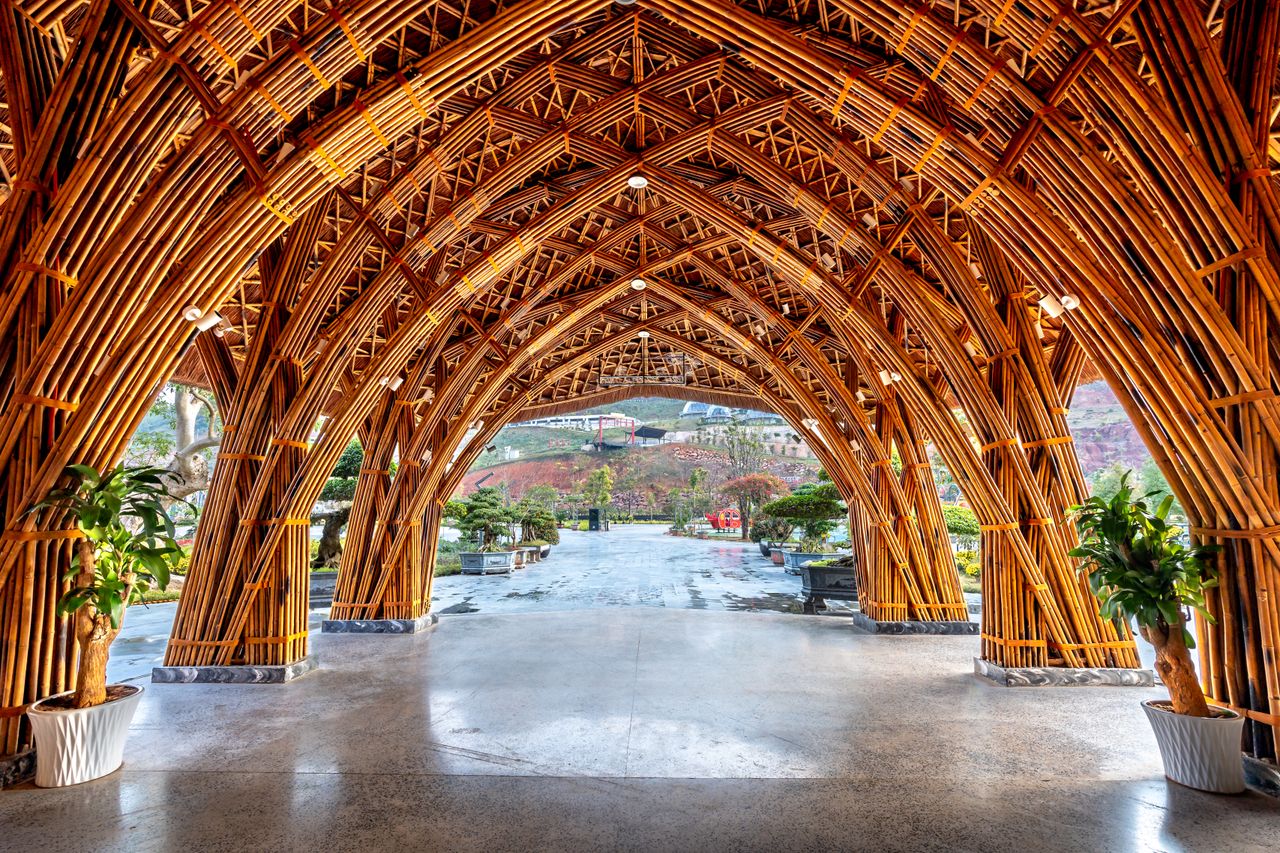
The festival's Landmark Project this year is The Pangolin Shield by Studio Saar, an Anglo-Indian practice, engineered with Atelier One. It's a bamboo structure built from overlapping woven shields — the form reads from the pangolin's scales and from the woven shields used by farming communities in north-eastern India. Wallpaper* framed the piece as an invitation to think about colonial histories, the movement of people, and the stories that materials carry. That's the curatorial reading, and it's a fair one.
The structural reading is just as interesting to me. This is bamboo, doing real work, on a public street in a country whose building culture runs on brick and steel. Not a sample. Not a render.
What reaches a house: repetition as a material strategy. One inexpensive element, repeated with discipline, outperforms one expensive feature almost every time. That's slat walls, reeded glass, a single tile laid in an unusual coursing, a run of identical spindles. Clients ask me for a statement; the honest answer is usually a pattern.
Light treated as a material, not a fixture
Mykola Kabluka is showing two light works inside St Paul's Cathedral, Soul and The Point of Unity, the second built from roughly 3,500 fibre-optic points. A cathedral is an unfair advantage — you get a dome to play against — but the principle scales down.
What reaches a house: stop thinking about light fittings and start thinking about where light lands. Most Toronto condos and renovations I inherit have the same problem: a grid of flat pot lights washing everything to the same even, characterless level. Points of light at different heights — a low table lamp, a picture light, one pendant at eye level — do more for a room at 9 p.m. than four more recessed cans ever will. The cathedral version costs a fortune. The domestic version costs three lamps and a dimmer.
Craft, with the sawdust still on the floor
The strongest thread running through this year's programme is making, performed in public rather than finished in a workshop and photographed later.
- Finding Form, Byron Pritchard, Cromwell Mews — live woodworking, responding to the grain in front of him instead of executing a preset drawing.
- The Speaking Oasis, Shahad Alazzaz, Cromwell Place — an exploration of date palm weaving techniques.
- Sanctum of Renewal, Mali Mowcka, at UBA in Shoreditch — between 160 and 200 hand-carved wooden forms suspended above a restaurant that keeps serving underneath them.
Brompton Design District ran its programme under the title Perfectly Imperfect, which is about as direct a statement of the year's mood as you'll get.
What reaches a house: one made thing per room. Not a room of made things — that's a craft fair, and it exhausts the eye. One object with a visible hand in it, surrounded by ordinary furniture, does the work. And the corollary, which is harder: stop hiding the joinery. A mitred corner, a visible dowel, an exposed edge grain on a shelf — these read as confidence. Filled, sanded, and sprayed to look machine-made reads as nothing at all.
Where the institutions went
The V&A is running Awakenings, Craft x Tech, and MixZ. The Design Museum has Simone Brewster's Platform and a Nigo retrospective. The Barbican has the Made x Barbican collection. Ham House, out in Richmond, was handed to Kingston University students for Past Made Present — a seventeenth-century house reinterpreted by people who weren't born when its last restoration finished. Dezeen's round-up flagged a contemporary throne that works through colonial histories via reinterpreted Dutch marquetry, and Coade stone objects used as viewfinders onto architectural details nobody looks at any more.
Wallpaper*'s read of the whole programme: craft paired with artificial intelligence, and migration, ecology, and cultural exchange as the recurring subjects. Which is a fair summary of where design thinking actually is in 2026, and not a bad one-line brief for a house either.
What I'd ignore
Festival work is allowed to be impractical — that's the point of it — but some of it gets repackaged as a domestic trend within about six weeks, and that's where people lose money. I'd leave the thermochromic furniture, the one-off 3D-printed lighting, and anything whose main property is that it changes appearance on camera. A material that's interesting for eleven seconds is a bad thing to live with for eleven years.
The biomaterials thread is the one worth watching properly, and it's further along than the rest — I went through what you can genuinely specify in the piece on mycelium and biomaterials. For the acoustic angle on all this — why a room full of hard, beautiful surfaces feels wrong even when it photographs well — acoustic architecture covers it. And if you'd rather see this kind of work in person without a transatlantic flight, Interior Design Show Toronto is the closest equivalent on this side.
Festivals are where the industry argues with itself in public. Almost none of it belongs in your living room as-is, and all of it tells you what your contractor will be quoting on in three years. If you're planning work now and want to know which of these directions is actually worth paying for, book a consultation.
People also ask
- When is London Design Festival 2026?
- 12 to 20 September 2026, across more than 300 events and 11 design districts in London. It runs annually in September and has done since 2003, which makes it one of the fixed points in the design calendar alongside Milan in April and Interior Design Show Toronto in the winter.
- What is the Landmark Project at London Design Festival 2026?
- The Pangolin Shield by Anglo-Indian studio Studio Saar, engineered with Atelier One, installed on the Strand. It's a bamboo structure of overlapping woven shields, referencing both the pangolin's scales and the woven shields used by farming communities in north-eastern India. It's the festival's inaugural Landmark Project by Studio Saar.
- Is London Design Festival free to visit?
- The street installations and the district trails have always been free to walk, which is most of what the festival is. Individual museum exhibitions, talks, and some ticketed events are priced separately by the venue, so check each one rather than assuming. The V&A, the Design Museum, and the Barbican all run their own LDF programming with their own admission rules.
- How is London Design Festival different from Milan Design Week?
- Milan is built around Salone del Mobile, a furniture trade fair, with the city-wide Fuorisalone around it — it's where products launch and orders get written. London is city-wide from the start, anchored by museums and cultural institutions rather than a fairground, and it leans further toward material research, craft, and installation work than toward catalogue launches.
- Do I need to go to London to get anything out of the festival?
- No. Most of what matters filters out through Dezeen, Wallpaper*, and the studios' own documentation within days, and the ideas travel better than the objects do. Going is worth it if you specify materials professionally and want to touch them. For everyone else, the useful part is the direction, and the direction is legible from anywhere.