Seasonal · October 3, 2026
Spooky Season Interior Design That Still Works in March
The dark, candlelit feeling without the skeleton in the corner. Charcoal paint, warm lamps, and the materials that still work after Halloween.

The request usually arrives as a screenshot. Black walls. A hundred candles. A skeleton in the corner of the frame. Then they tell me the room is the bedroom.
Spooky, as a costume, is easy. Spooky, as a room you still make the bed in, is a lighting and materials problem. Halloween can borrow the mood for a month. The mood only earns a place in the house if it still feels like yours in March, when nobody is handing out candy and the window is just a window.
A costume and a room are different briefs
I split them so they stop wrecking each other. The costume is the door, the party table, the thing that packs into a bin. That is Halloween interior design, and it has an end date. The room is paint, lamps, metal, and cloth. It does not get a skeleton to make the point.
If you only want the feeling for October, do not paint. Dim the lamps, bring in candlelight for the evenings you are home, and put it away. Paint is how you say the feeling is allowed to stay.
Paint is the decision that stays
Pure black is the wrong first move in most bedrooms. It swallows a north window, and Toronto in February does not give you much window to spare. A charcoal, or a soft black with a little colour in it, keeps the corners dark and lets the architecture still read.
Three I actually put on cards and hold up to the wall:
- Benjamin Moore Kendall Charcoal HC-166. The lighter of the group. Easier in a bedroom, and less likely to turn a small room into a hole.
- Sherwin-Williams Iron Ore SW 7069. Darker, with a brown-black note. Strong on a single wall, a door, or millwork. Heavy if you wrap all four walls in a dim room.
- Farrow & Ball Railings No. 31. A soft black with a blue undertone. It holds more life in low light than a dead flat black, which is why it keeps showing up on doors and window frames and then, later, on walls.
Sample pots, large patches, more than one wall. Look in the morning and under your own bulbs at night. A chip under store lighting will lie to you. The same rule I use for any paint job, including the colour capping technique if a full dark envelope is more than the room wants. A cap, or one wall, is often the honest size of the idea.
A charcoal bedroom with an arched window is the proportion I mean. The dark is the envelope. The bedding and the daylight stay lighter, so the bed does not disappear into the wall. You should be able to photograph it at noon and still see a bedroom.
The mood is the light
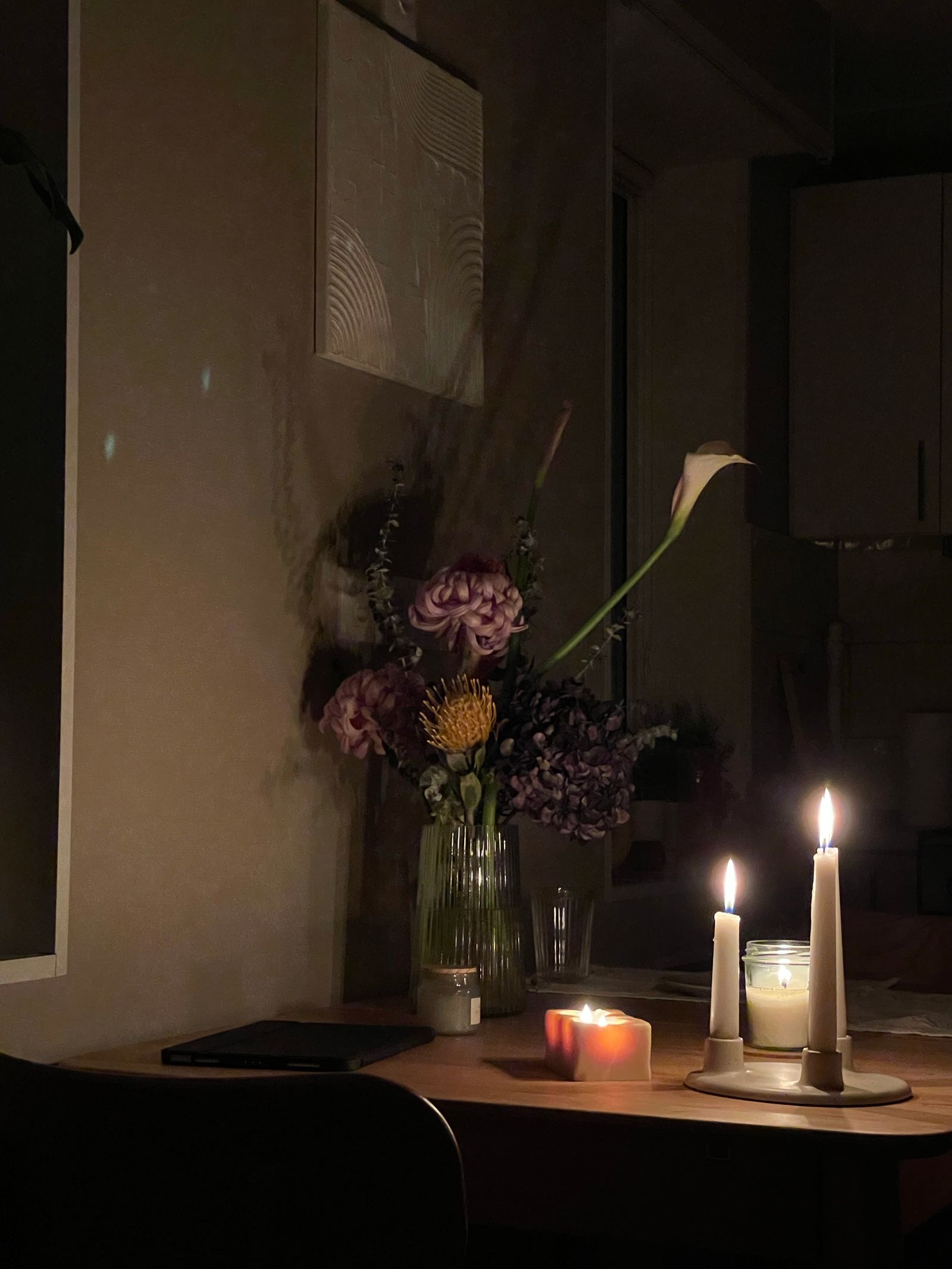
Charcoal under a cool 4000K pot light looks grey and dirty. The same paint under a 2700K lamp at half brightness looks like evening on purpose. If you change only one thing, change the bulbs and turn the overhead off. People blame the colour for a lighting mistake constantly.
Candles are a guest, not the lighting plan. Two or three on a night you want them. A room that only functions by open flame is not finished. Lamps at the bed, a lamp by the chair, a path to the door. Then the candles, if you want them.
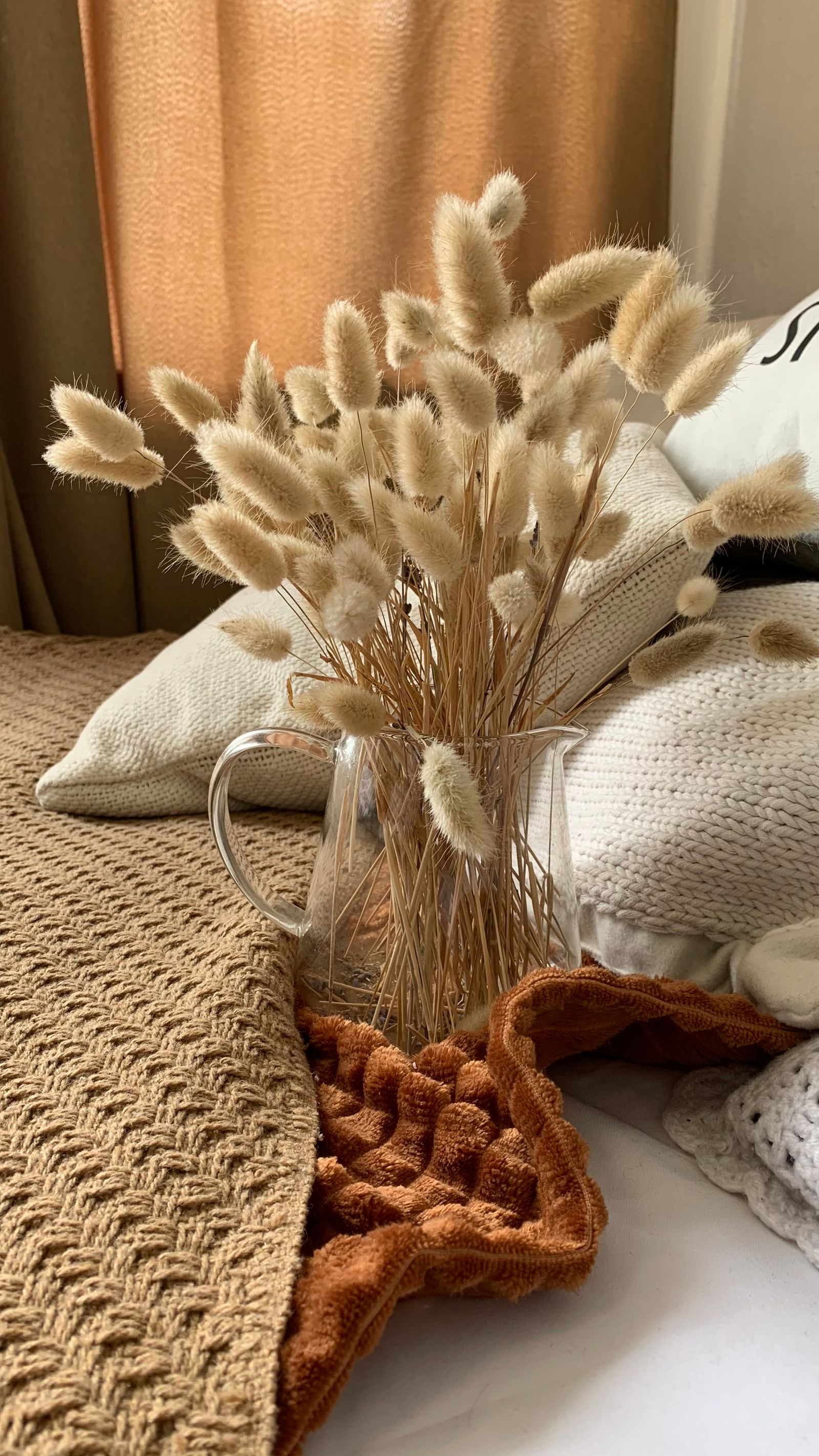
The rust-and-cream version of seasonal dark, dried grass and a throw, is the autumn edit, and it is lighter than this on purpose. I wrote that separately in autumn interior design. Use that when you want warmth. Use this when you want night.
Materials that read as night
Walnut. Blackened steel on a lamp or a shelf bracket. Unlacquered brass, left alone so it darkens instead of being polished back to a showroom shine. Wool. Lime plaster or a matte paint, not a gloss that mirrors the opposite wall. One oxblood note, a cushion or a lamp base, so the dark has a temperature.
What fails is the matching set: glossy black side tables, a black bed, a black rug, a black lamp, bought in one click. The room looks specified by a filter. Mix a dark wall with a warm floor and a textile you already own. The contrast is what makes it feel considered at 8 a.m., not only at 8 p.m.
Where it fails
Kids' rooms. A child who wants spooky for a week does not want charcoal at bedtime in January. Give them the Halloween layer, the one that packs away, and keep the envelope light.
Basements with a single small window. I will do a dark headboard wall there. I will argue against four dark walls. You can test it. You will repaint it.
Bathrooms in a glossy black that shows every water spot and every dried drip. Matte dark tile or paint can work in a powder room with a good mirror and a warm sconce. A windowless bath wrapped in gloss black does not.
And the whole apartment. One dark room in a house of warmer ones feels like a choice. Every room the same charcoal feels like a cave you have to cross to find your keys. Pick the bedroom, the study, or the dining room. Let the kitchen stay a kitchen.
If you are deciding between a sample pot and a full repaint, that is ordinary residential interior design work: the wall, the lamps, what the room is doing in February. Book a consultation and bring a photo of the window wall in the morning. That photo answers half the question before anyone opens a fan deck.
People also ask
- What is spooky season interior design?
- A dark, low-lit room you can keep after Halloween: charcoal or soft-black paint, warm lamps, blackened metal or walnut, and one deep accent such as oxblood. It is not plastic bats, spiderweb, or a skeleton in the corner. Those come down on November 1. The paint does not.
- Should I paint a room black for Halloween?
- Not for Halloween. Paint is a year-round decision, and a pure black in a north-facing Toronto bedroom will swallow the window in February. If you want dark, test a charcoal such as Benjamin Moore Kendall Charcoal HC-166, Sherwin-Williams Iron Ore SW 7069, or Farrow & Ball Railings No. 31 on the wall for a few days. If you only want dark for October, dim the lights and skip the paint.
- Will dark walls make a room feel smaller?
- They make the corners recede when the light is warm and layered, and they make a room feel like a cave when the only light is a cool ceiling pot at full brightness. In a small condo, paint one room or one wall, not the whole apartment. Keep the trim and the bedding lighter than the wall so the bed still reads as the bright thing.
- How is spooky season design different from Halloween decorating?
- Halloween decorating is temporary: the door, one table, props that pack away on November 1. Spooky season design is the part you would still want on a Tuesday in March. If it cannot survive daylight and a normal morning, it is a costume, and it belongs in the Halloween plan instead.
- What materials read as night without looking like a set?
- Walnut, blackened steel, unlacquered brass that is allowed to darken, wool, and plaster. One oxblood cushion or lamp base is enough accent. Glossy black furniture in a matching set reads as a catalogue. Matte dark walls with warm textiles read as a room.
- Can a dark bedroom work with almost no daylight?
- A basement bedroom with one small window is the case where I talk people out of a full charcoal envelope. You can still have a dark headboard wall, a wool throw, and warm lamps. Four dark walls plus no daylight is a room you will repaint in February. Test the colour on that window wall first, and look at it at 8 a.m.